

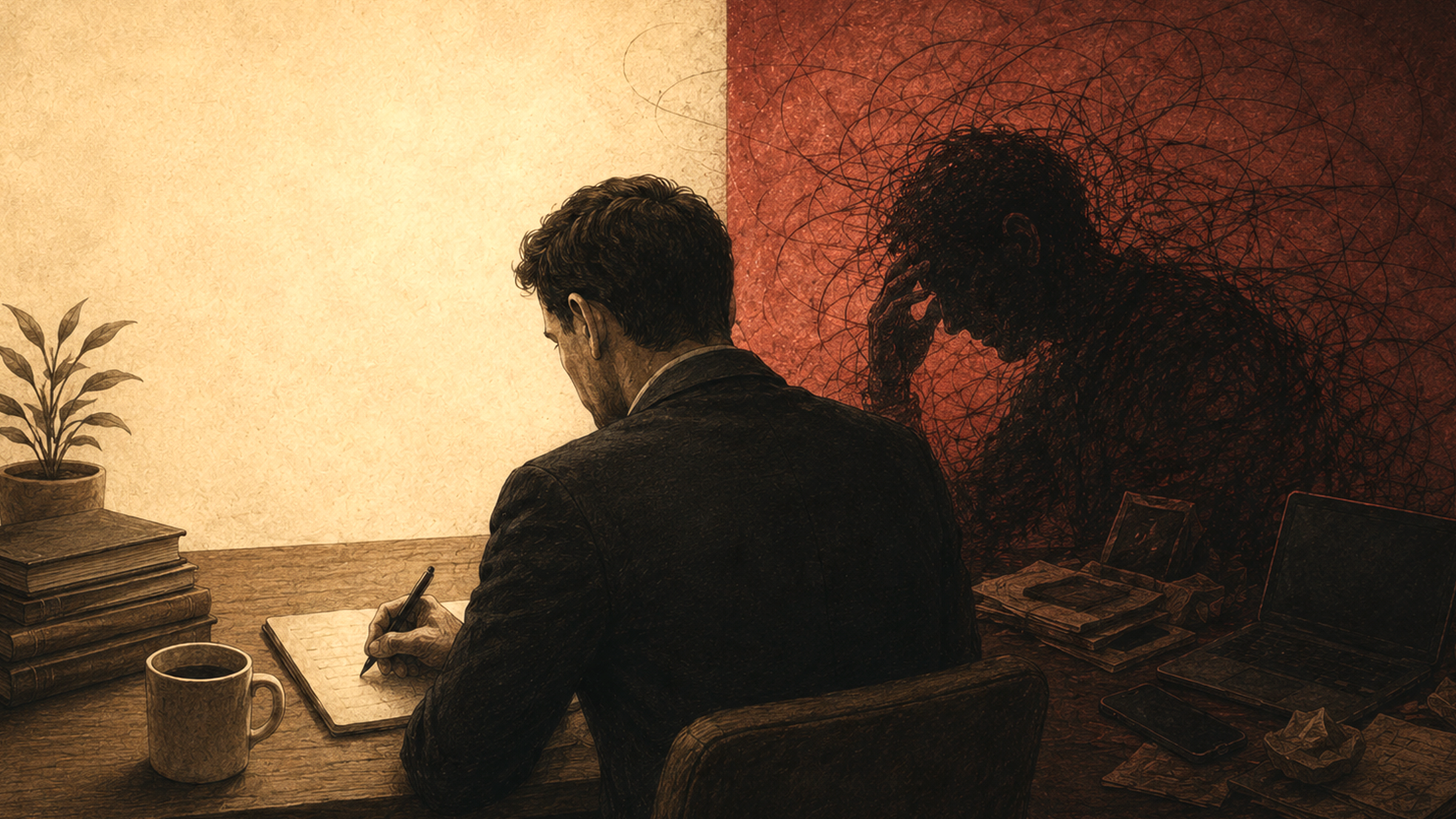
When most people hear the word “addict,” they picture someone whose life has fallen apart
But there’s another kind.
The high-functioning addict.
They:
- Show up to work.
- Pay their bills.
- Exercise.
- Read books.
- Look fine
On paper, they’re thriving.
Internally, they’re exhausted
Success Can Hide Compulsion
High-functioning addiction doesn’t always look destructive.
Sometimes it looks admirable.
Workaholism.
Hyper-productivity.
Relentless self-improvement.
Obsessive goal-setting.
Behavior Is Downstream of Fear.
In many environments, these traits are rewarded.
But reward doesn’t mean healthy.
It just means profitable.
The Real Marker: Unmanageability
In recovery circles, addiction isn’t defined by how bad it looks.
It’s defined by unmanageability.
Ask yourself:
- Do you say you’ll stop — and then don’t?
- Do you feel restless when you’re not “doing” something?
- Do you use busyness to avoid difficult conversations?
- Does your mind race when you try to rest?
You may not be falling apart externally.
But if your inner world feels chaotic,
you may be running on compulsion.

My Version of It
I wasn’t gambling away savings.
I was overworking.
Gaming well after midnight.
Escaping into screens.
And justifying it because I was “productive.”
It took me years to admit that my life was technically manageable but internally unmanageable.
That distinction changed everything.
Why This Matters
If you don’t identify as “an addict,” you won’t seek recovery.
You’ll just keep optimizing.
And optimizing is socially acceptable avoidance.
The high-functioning addict doesn’t crash dramatically.
They slowly numb out.
What Recovery Actually Means
It’s learning how to:
- Stop running from silence.
- Feel emotions without fixing them.
- Admit you can’t self-improve your way out of fear.
- Let go of the illusion of control
That’s not weakness.
It’s maturity.
If you see yourself in this, I write about emotional sobriety and modern addictions twice a month. You can join here.