

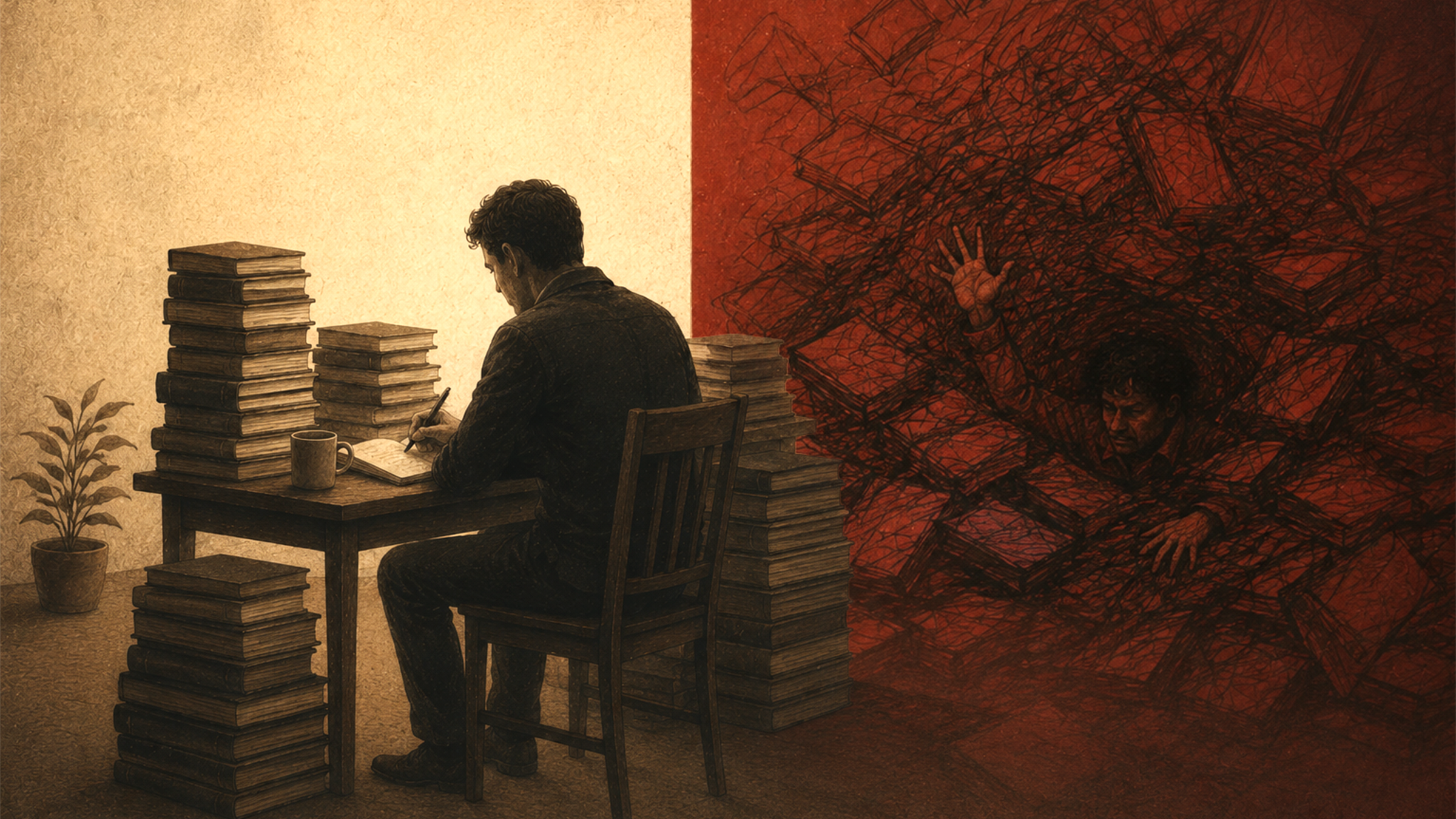
You’ve read the books.
Listened to the podcasts.
Downloaded the habit trackers.
Reimagined the morning routine. (Again.)
And yet — you still feel stuck.
Not ignorant. Not lazy. Not incapable.
Just… stuck.
Most Self-Help Assumes Your Problem Is Tactical.
You need:
• Better goals
• More discipline
• A better system (or better AI prompts)
• Stronger habits
But what if your problem isn’t tactical?
What if it’s emotional?
The Hidden Assumption of Self-Help
Most self-help is built on a simple premise:
If you change your behavior, you’ll change your life.
And sometimes that’s true.
But here’s what it often ignores:
Behavior Is Downstream of Fear.
Consider this:
You don’t overwork because you haven’t optimized your calendar. You overwork because being still feels unsafe.
You don’t doom-scroll because you lack time-management skills. You scroll because silence (or lack of activity) makes you uncomfortable.
You don’t binge Netflix because you forgot your goals. You binge because the alternative is feeling something you’d rather avoid.
You don’t overwork because your calendar is inefficient.
You overwork because being still feels unsafe.
You don’t scroll because you lack discipline.
You scroll because silence feels uncomfortable.

Self-Help Treats Behaviors. Recovery Treats the Fear Underneath.
The Dopamine Loop Isn’t the Whole Story
Neuroscience has taught us a lot about dopamine, reward pathways, and habit loops.
And that science is helpful.
But dopamine isn’t the villain.
Fear is.
Fear of:
• Being insignificant
• Being rejected
• Being alone
• Being exposed
• Being inadequate
Compulsive behavior is often just a nervous system trying to regulate itself.
Your brain is not broken. It’s protecting you.
For years I asked the wrong question.
How can I optimize my habits?
But nothing changed until I asked something different.
What am I afraid to feel?
Sometimes Self-Help Becomes the Addiction.
The cycle looks like this:
Anxiety → self-help content → temporary hope → crash → repeat
It feels productive.
But dopamine isn’t the villain.
But it’s still avoidance.
You feel anxious so you consume content about “x, y or z” so you get a dopamine hit. Anything to NOT feel anxiety.
You’re medicating discomfort with “improvement.” And improvement can be just as numbing as scrolling.
What Actually Works
If behavior isn’t the root problem, then what is?
“How can I optimize my habits?”
In my own life, nothing changed until I stopped asking:
And started asking:
“What am I afraid to feel?”
That shift moved me from self-help to emotional sobriety.
Emotional sobriety isn’t about eliminating bad habits overnight.
Emotional sobriety isn’t about eliminating bad habits
overnight. It’s about learning to sit with discomfort,
naming fear honestly, and reconnecting with something
bigger than your ego.
It’s about:
• Learning to sit with discomfort
• Naming fear honestly
• Admitting where you’re powerless
• Reconnecting to something bigger than your ego
For me, that looked like recovery principles applied to modern professional life.
Not religion. Not hustle culture. Not toxic positivity.
Just honesty.
If You’re Tired
If you’re exhausted from trying to fix yourself… If you secretly feel like none of the advice has touched the real problem…
You’re not a failure.
You may just be treating a spiritual and emotional wound with tactical tools.
And tactical tools can’t heal fear.